




Description
Purchase Orders: Click “Add to Cart” button to order, then email PO to orders@altogen.com.
Product Availability: In Stock.
Transfection Reagent for Fibroblast Cells (Fibroblast Cell Lines and Primary Fibroblasts)
- Proprietary cationic lipid formulation
-
High transfection efficiency of small RNA (siRNA, shRNA, miRNA), mRNA, and plasmid DNA
-
Effective and robust intracellular delivery
-
Kit includes Transfection Enhancer and Complex Condenser reagents
-
Work in the presence of serum
-
A proven reagent for establishing stable fibroblast cell lines
-
Download Fibroblast transfection protocol: [PDF]
- Download Fibroblast CRISPR/Cas9 transfection protocol: [PDF]
-
Download PowerPoint presentation for Fibroblast cells transfection kit: [PPT]
- UPC/GTIN/EAN: 860002089767
-
Brand: ALTOGEN®, developed and manufactured by Altogen Biosystems
Transfection Efficiency:
Reagent exhibits at least 85% transfection efficiency of siRNA delivery. Transfection efficiency was determined by qRT-PCR.
Product Description:
Transfection kit is specially designed for fibroblast cell lines and primary fibroblast cultures. Transfection reagent supplemented by complex condenser and transfection enhancer ensuring high efficiency in delivering cargo biomolecules into fibroblast cells.
Transfection Protocol and SDS:
Download Altogen Biosystems Fibroblasts Transfection Protocol: [PDF]
Download SDS: [PDF]
Fibroblast Cell Lines and Primary Fibroblasts:
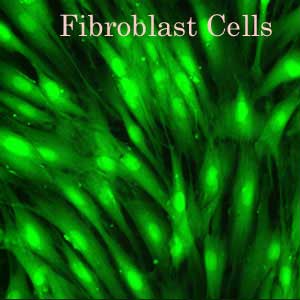
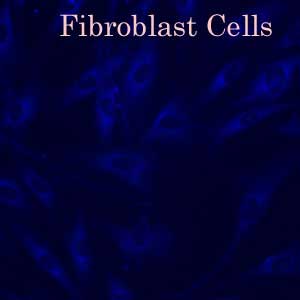
Fibroblasts maintain the structure of connective tissues by secreting precursors of the extracellular matrix, primarily a variety of fibers and the ground substance. Fibroblasts and related connective tissues sculpt the significant portion of an organism. Fibroblasts are derived from primitive mesenchyme. Fibroblasts have a branched cytoplasm that surrounds a nucleus with one or two nucleoli. Fibroblasts can migrate slowly over substratum as individual cells (in contrast to epithelial cells). Fibroblasts can show different phenotypes in separate anatomical locations. Active fibroblasts have rough abundant endoplasmic reticulum. Fibroblasts often align in parallel clusters when crowded. Unlike the epithelial cells lining the body structures, fibroblasts do not form flat mono-layers and are not restricted to a basal lamina on one side. Of the total tissue mass in the human body, approximately 45% is made up of connective tissue. Within the cells that make up connective tissue, fibroblasts are the most prolific. Fibroblasts secrete extracellular proteins that help maintain the structure of connective tissue. Fibroblasts are well known for the role they play in wound healing, by synthesizing collagen at the site of an injury. Many studies have successfully demonstrated the ability of healthy fibroblasts to convert into different functional cells. Fibroblasts are characterized by their elongated shape and their ability to produce and secrete extracellular matrix (ECM) components such as collagen, elastin, and fibronectin. They are involved in wound healing, tissue remodeling, and the formation of scar tissue. Fibroblasts are commonly used in cell culture studies as a model system for studying the biology of connective tissue cells, as well as for drug screening and toxicity testing. Altogen Biosystems manufactures optimized cationic lipid-based transfection reagent kits suitable for carrying out transfection on various fibroblast cell lines.
Data:
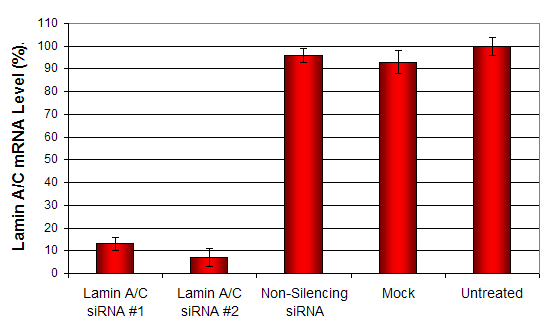
Figure 1. siRNAs targeting Lamin A/C mRNA or non-silencing control siRNA were transfected into fibroblast cells following the recommended protocol. At 48 hours post-transfection the cells were analyzed by qRT-PCR for gene expression levels. 18S rRNA levels were used to normalize the Lamin A/C data. Values are normalized to untreated sample. Data are means ± SD (n=3).
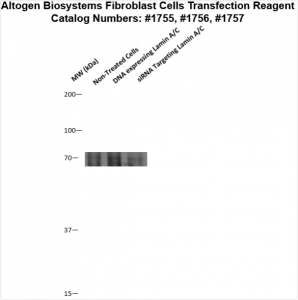
Figure 2. Protein expression of Lamin A/C in Fibroblast cells. DNA plasmid expressing Lamin A/C or siRNA targeting Lamin A/C were transfected into Fibroblast cells following Altogen Biosystems transfection protocol. At 72 hours post-transfection the cells were analyzed by Western Blot for protein expression levels (normalized by total protein, 10 µg of total protein loaded per each well). Untreated cells used as a negative control.
Selected Fibroblast transfection kit citations and references:
- Journal of Experimental Medicine. 2015. 212 (7) 1061-1080. The Dishevelled-binding protein CXXC5 negatively regulates cutaneous wound healing. Kim et al [PDF]
- Am J Pathology. 2011. 179(4):1792-806. Defective myofibroblast formation from mesenchymal stem cells in the aging murine heart rescue by activation of the AMPK pathway. Cieslik et al [PDF]
- Rep Biochem Mol Biol. 2015. Apr;3(2):76-81.Expression of TGF-β3 in isolated fibroblasts from foreskin. Mahmoudi et al [PDF]
- The American Journal of Pathology. 2011 179(4). Defective Myofibroblast Formation from Mesenchymal Stem Cells … Cieslik et al [PDF]
Altogen Biosystems is a life sciences company that offers cell type-specific and pre-optimized transfection products, elecroporation kits, and in vivo delivery reagents. Advanced formulation of reagents and optimized transfection protocols provide efficient intracellular delivery of protein, DNA, mRNA, shRNA and siRNA molecules. Read more about transfection technology at Altogen’s Transfection Resource. Altogen Labs provides safety and efficacy preclinical research services. GLP-compliant studies for IND applications, and drug development, including over 90 in-house validated xenograft models, safety toxicology, etc (visit AltogenLabs.com).
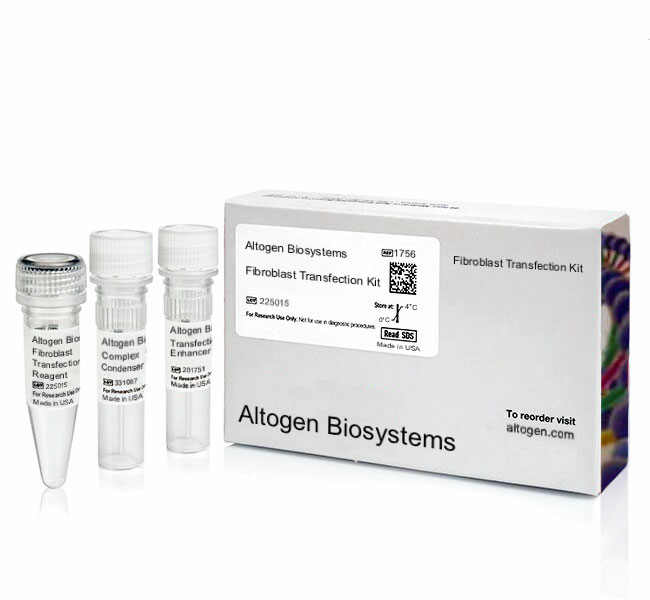
Volume Options:
- 0.5 ml (Catalog #1755)
- 1.5 ml (Catalog #1756)
- 1.5 ml CRISPR (Catalog #2142)
- 8.0 ml (Catalog #1757)
Purchase Orders: Click “Add to Cart” button to order, then email PO to orders@altogen.com.
Product Availability: In Stock.