




Description
Purchase Orders: Click “Add to Cart” button to order, then email PO to orders@altogen.com.
Product Availability: In Stock.
Transfection Reagent for HEK293 Cells (Epithelial Kidney Cells, CRL-1573)
-
Two component formulation enhances lipid mediated transfection efficiency
-
Optimized easy-to-use transfection protocol provided for transfection of siRNA, DNA, mRNA, and microRNA
-
Kit includes Transfection Enhancer reagent and recommended transfection protocol
-
High transfection efficacy in the presence of serum
-
Expand your RNAi application with a reagent optimized for delivery of both siRNA and plasmid
-
Works well for standard reverse transfection and high-throughput applications
-
Download HEK293 transfection protocol: [PDF]
- Download HEK293 CRISPR/Cas9 transfection protocol: [PDF]
- Download PowerPoint presentation for HEK293 cells transfection kit: [PPT]
- UPC/GTIN/EAN: 860002089761
-
Brand: ALTOGEN®, developed and manufactured by Altogen Biosystems
Transfection Efficiency:
Reagent exhibits at least 90% transfection efficiency of siRNA delivery. Transfection efficiency was determined by qRT-PCR.
Product Description:
Transfection reagent is specially designed for HEK293 cellline, a human epithelial kidney cells. High efficiency delivering both DNA and RNA into HEK293 cells.
Transfection Protocol and SDS:
Download Altogen Biosystems HEK-293 Transfection Protocol: [PDF]
Download SDS: [PDF]
HEK-293 Cell Line:
Human embryonic kidney cells have high transfection efficiency and are commonly used in cancer research as well as for pharmaceutical and biomedical purposes. HEK-293 human epithelial kidney cells were originally derived in 1977 from human embryonic kidney cells transformed with sheared adenovirus 5 DNA grown in tissue culture. The transformation incorporated approximately 4.5 kilobases from the viral genome into human chromosome 19 of the HEK cells. HEK has been described as being a cellular test tube. These cells were developed from embryonic kidney cells, and are useful in a variety of molecular and biological research, many of which have medical applications. In addition to being reliable hosts for transfection, HEK-293 cells are particularly helpful for the production of therapeutic proteins as well as viruses for gene therapy. Altogen Biosystems offers pre-optimized advanced formulation of lipid-based transfection reagent kits for human epithelial kidney cells that yield at least 90% transfection efficiency, as verified by qPCR.
HEK293 is a commonly used cell line in biological research that was originally derived from human embryonic kidney cells in 1973. The “HEK” in the name stands for “human embryonic kidney,” and “293” refers to the fact that the cells were derived from the 293rd experiment in a series of attempts to transform the cells with adenovirus 5 DNA. The HEK293 cell line is widely used in molecular biology, genetics, and biomedical research to study gene expression, protein production, protein interactions, and protein purification. The cells are easy to culture and maintain, grow quickly, and can be transfected with high efficiency, allowing researchers to study the function of specific genes and proteins. HEK293 cells are often used to produce recombinant proteins and to generate viral vectors for gene therapy. They are also used in drug discovery to screen for potential therapeutic compounds and to study the mechanisms of drug action. HEK293 cells have been extensively characterized at the genetic and molecular levels, and their genome has been fully sequenced.
Mutations:
| JAK1 | 3716 | 37 | 1 | 65321323 | 65321323 | Missense_Mutation | SNP | C | T |
| FAM72D | 728833 | 37 | 1 | 143897564 | 143897564 | Missense_Mutation | SNP | C | G |
| PEX11B | 8799 | 37 | 1 | 145522695 | 145522695 | Silent | SNP | C | T |
| CLK2 | 1196 | 37 | 1 | 155236668 | 155236668 | Missense_Mutation | SNP | A | C |
| TBX19 | 9095 | 37 | 1 | 168274375 | 168274375 | Missense_Mutation | SNP | G | A |
| THADA | 63892 | 37 | 2 | 43735879 | 43735879 | Silent | SNP | G | A |
| SOWAHC | 65124 | 37 | 2 | 110373301 | 110373301 | Missense_Mutation | SNP | G | T |
| RBM45 | 129831 | 37 | 2 | 178988620 | 178988620 | Missense_Mutation | SNP | C | G |
| STK36 | 27148 | 37 | 2 | 219540162 | 219540162 | Missense_Mutation | SNP | G | A |
| SLC4A3 | 6508 | 37 | 2 | 220502939 | 220502939 | Silent | SNP | C | G |
| FANCD2 | 2177 | 37 | 3 | 10089601 | 10089601 | Splice_Site | SNP | G | A |
| SUSD5 | 26032 | 37 | 3 | 33195339 | 33195339 | Missense_Mutation | SNP | C | T |
| TOPBP1 | 11073 | 37 | 3 | 133327463 | 133327463 | Silent | SNP | A | G |
Data:
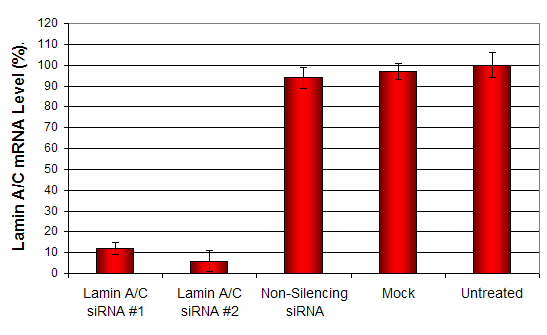
Figure 1. SiRNAs targeting Lamin A/C mRNA or non-silencing control siRNA were transfected into HEK-293 cells following the recommended protocol. At 48 hours post-transfection the cells were analyzed by qRT-PCR for gene expression levels. 18S rRNA levels were used to normalize the Lamin A/C data. Values are normalized to untreated sample. Data are means ± SD (n=3).
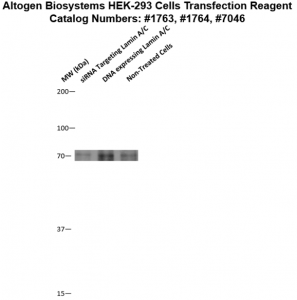
Figure 2. Protein expression of Lamin A/C in HEK-293 cells. DNA plasmid expressing Lamin A/C or siRNA targeting Lamin A/C were transfected into HEK-293 cells following Altogen Biosystems transfection protocol. At 72 hours post-transfection the cells were analyzed by Western Blot for protein expression levels (normalized by total protein, 10 µg of total protein loaded per each well). Untreated cells used as a negative control.
Selected in vivo transfection product citations (ALTOGEN® IN VIVO Transfection Kits used in the following publications):
- Am J Pathology. 2010 177(4):1870-80. Role of ocular complement factor H in a murine model … Lyzogubov et al [PDF]
- Jounal of Biological Chemistry. 2012 287(4):2907. Chaperoning of mutant p53 protein … Gogna et al [PDF]
- PLoS Pathogens. 2012 8(8) Uridine composition of the poly-U/UC tract of HCV RNA … Schnell et al [PDF]
- J Proteome Res. 2012(11) Retinal proteome analysis in a mouse model of oxygen-induced … Kim et al [PDF]
- J Transl Med. 2010 15;8:133. Prevention of hyperglycemia-induced myocardial apoptosis … Zhang et al [PDF]
Altogen Biosystems is a life sciences company that offers cell type-specific and optimized transfection products, electroporation kits, and in vivo delivery reagents. Advanced formulation of reagents and optimized transfection protocols provide efficient cellular delivery of protein, DNA, mRNA, shRNA and siRNA molecules. Read more about transfection technology at Altogen’s Transfection Resource. Altogen Labs provides GLP compliant contract research studies for preclinical research, IND applications, and drug development. Biology CRO services include: Xenograft models (90+), development of stable cell lines, ELISA assay development, cell-based and tissue targeted RNAi studies, safety pharm/tox assays, and other studies (visit AltogenLabs.com).
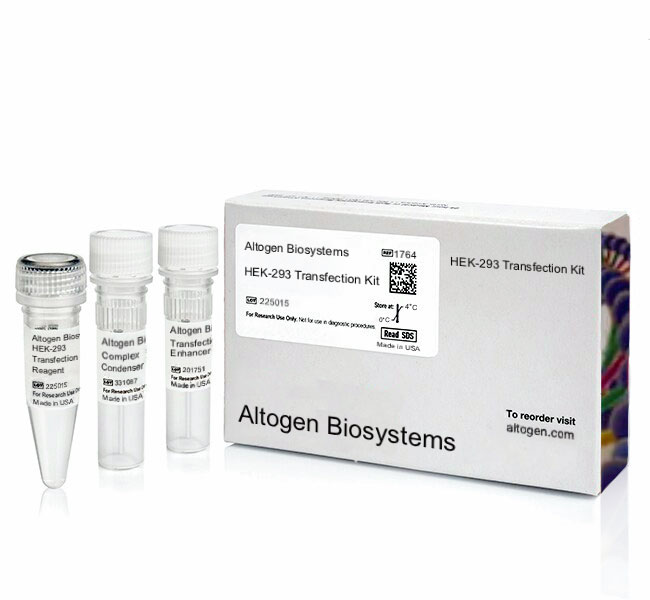
Volume Options:
- 0.5 ml (Catalog #1763)
- 1.5 ml (Catalog #1764)
- 1.5 ml CRISPR (Catalog #2149)
- 8.0 ml (Catalog #7046)
Purchase Orders: Click “Add to Cart” button to order, then email PO to orders@altogen.com.
Product Availability: In Stock.