




Description
Purchase Orders: Click “Add to Cart” button to order, then email PO to orders@altogen.com.
Product Availability: In Stock.
Transfection Reagent for HepG2 Cells (Hepatocellular Carcinoma Cells, HB-8065)
- Proprietary cationic lipids formulation
-
High transfection efficiency of small RNA (siRNA, shRNA, miRNA), mRNA, pDNA
-
Effective and robust intracellular delivery
-
Kit includes Complex Condenser and Transfection Enhancer reagents
-
Produces consistent results, lot-to-lot, plate-to-plate, and well-to-well
-
Work in the presence of serum
-
A proven reagent for establishing stable cell lines
-
Optimized transfection protocols are adapted for use with both standard & reverse transfection methods
-
Download in vitro HepG2 transfection protocol: [PDF]
- Download HepG2 CRISPR/Cas9 transfection protocol: [PDF]
-
Download PowerPoint presentation for HepG2 cells transfection kit: [PPT]
- UPC/GTIN/EAN: 860002089772
-
Brand: ALTOGEN®, developed and manufactured by Altogen Biosystems
Transfection Efficiency:
Reagent exhibits at least 90% transfection efficiency of siRNA delivery. Transfection efficiency was determined by qRT-PCR.
Product Description:
Optimized transfection reagent for HepG2 cell line provides high transfection efficiency and low cytotoxicity. Transfection reagent supplemented by complex condenser and transfection enhancer ensures high efficiency in delivering cargo biomolecules into HepG2 cells.
Transfection Protocol and SDS:
Download Altogen Biosystems HepG2 Transfection Protocol: [PDF]
Download SDS: [PDF]
HepG2 Cell Line:
HepG2 is a human liver cancer cell line that was originally derived from a patient with hepatocellular carcinoma. Cell line is known for the sensitivity to a variety of chemotherapeutic agents, including cisplatin and doxorubicin. Researchers also use HepG2 cell line to investigate the molecular mechanisms underlying liver cancer. Liver cancer is highly aggressive and devastating disease that features several main characteristics, including a high rate of recurrence, low early detection rate and ineffective treatment approaches. In addition to being the fifth common malignancy, it is considered the second primary cause of cancer-related mortalities worldwide, as stated by Oncotarget, published in July 2015. The HepG2 hepatoma cell line is important for the toxicological assessment of novel combinatorial drugs. HepG2 was derived from the liver tissue of a 15-year-old male with differentiated hepatocellular carcinoma. These cells are epithelial and have a model chromosome number of 55. HepG2 cells secrete a variety of major plasma proteins, including albumin, transferrin, alpha 1-antitrypsin, alpha 2-macroglobulin, and plasminogen (they have been grown successfully in large-scale cultivation systems). The cells are responsive to stimulation with human growth hormone. HepG2 cells have also been shown to be resistant to G418. HepG2 cells and their derivatives are used as a model system for studies of liver metabolism and toxicity of xenobiotics, antigenotoxic and cogenotoxic agents, understanding hepatocarcinogenesis, the detection of cytoprotective, and for drug targeting studies. Also, HepG2 cells are commonly employed in trials with bio-artificial liver devices. This cell line is widely used in human cancer research of the liver and is essential for many different types of biomedical research. Altogen Biosystems offers highly efficient transfection reagent kits for the HepG2 hepatoma cell line.
Mutations:
| PREX2 | 80243 | 37 | 8 | 68930087 | 68930087 | Missense_Mutation | SNP | T | G |
| OR1S2 | 219958 | 37 | 11 | 57971241 | 57971241 | Missense_Mutation | SNP | G | T |
| SLC8A3 | 6547 | 37 | 14 | 70634539 | 70634539 | Nonsense_Mutation | SNP | G | A |
| SLC26A11 | 284129 | 37 | 17 | 78220405 | 78220405 | Silent | SNP | G | T |
| SIRPG | 55423 | 37 | 20 | 1615981 | 1615981 | Missense_Mutation | SNP | G | A |
| RNF223 | 401934 | 37 | 1 | 1007675 | 1007675 | Missense_Mutation | SNP | G | C |
| DVL1 | 1855 | 37 | 1 | 1284367 | 1284367 | Missense_Mutation | SNP | G | A |
| PLEKHG5 | 57449 | 37 | 1 | 6556600 | 6556600 | Missense_Mutation | SNP | G | C |
| TNFRSF1B | 7133 | 37 | 1 | 12254044 | 12254044 | Silent | SNP | C | T |
| PRAMEF10 | 343071 | 37 | 1 | 12953005 | 12953005 | Silent | SNP | G | A |
| PRDM2 | 7799 | 37 | 1 | 14106669 | 14106669 | Silent | SNP | A | G |
Data:
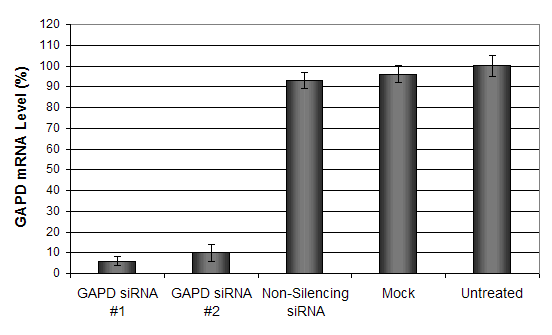
Figure 1. GAPD mRNA levels were quantified using real-time RT-PCR in the HepG2 cells transfected with siRNAs targeting GAPD or non-silencing siRNA. Forty-eight hours post-transfection, the cells were harvested and analyzed by real-time RT-PCR for GAPDH mRNA expression levels. Data were normalized against the 18S rRNA signal. Control samples were either mock-transfected or untreated. Values are normalized to untreated sample. Data are means ± SD (n=3).
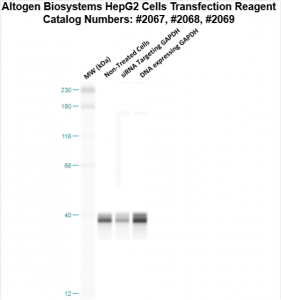
Figure 2. Protein expression of GAPDH in HepG2 cells. DNA plasmid expressing GAPDH or siRNA targeting GAPDH were transfected into HepG2 cells following Altogen Biosystems transfection protocol. At 72 hours post-transfection the cells were analyzed by Western Blot for protein expression levels (normalized by total protein, 10 µg of total protein loaded per each well). Untreated cells used as a negative control.
Selected HepG2 transfection reagent product citations:
- Journal of Molecular Endocrinology 2010. Identification of protein kinases that control ovarian hormone release … Sirotkin et al [PDF]
- FEBS Letters 2009 (583). MicroRNA 125a and its regulation of the p53 tumor suppressor gene … Zhang et al [PDF]
- Cellular Physiology 2011. Identification of MicroRNAs Controlling Human Ovarian Cell Proliferation … Sirotkin et al [PDF]
Selected in vivo transfection product citations (ALTOGEN® IN VIVO Transfection Kits used in the following publications):
- 2008 454(7203):523-7. Innate immunity induced by composition-dependent RIG-I …Saito et al [PDF]
- Am J Pathology. 2010 177(4):1870-80. Role of ocular complement factor H in a murine model … Lyzogubov et al [PDF]
- Nature Biotechnology. 2011 29(4):341-5. Delivery of siRNA to the mouse brain by … Alvarez-Erviti et al [PDF]
- Cancer Research. 2011 71(15):5144-53. Inhibition of miR-193a expression by… Iliopoulos et al [PDF]
- 2010 16(11):2108-19. RNase L releases a small RNA from HCV RNA that refolds … Malathi et al [PDF]
- 2012 55(7):2069-79. The p47phox- and NADPH oxidase organiser 1 … Youn et al [PDF]
- British Journal of Cancer. 2012 107(3):516-26. TIGAR induces p53-mediated cell-cycle … Madan et al [PDF]
- 2014 63(2):353-61. Tissue transglutaminase contributes to … Liu et al [PDF]
- Circulation Research. 2010 15;107(8). Kruppel-like factor-4 transcriptionally regulates … Cowan et al [PDF]
- 2012 59(1):158-66. Role of uncoupled endothelial nitric oxide synthase … Gao et al [PDF]
- Jounal of Biological Chemistry. 2012 287(4):2907. Chaperoning of mutant p53 protein … Gogna et al [PDF]
- PLoS Pathogens. 2012 8(8) Uridine composition of the poly-U/UC tract of HCV RNA … Schnell et al [PDF]
- J Proteome Res. 2012(11) Retinal proteome analysis in a mouse model of oxygen-induced … Kim et al [PDF]
- 2011 141(2) Differential type I interferon-mediated autophagic trafficking … Desai et al [PDF]
- PLoS Pathog. 2014 10(10) Exosomes from hepatitis C infected patients transmit HCV … Bukong et al [PDF]
Altogen Biosystems manufacturers over 100 pre-optimized in vitro transfection kits for cancer cell lines and primary cells, elecroporation products, and tissue-targeted in vivo delivery reagents for life science research. Advanced formulation of reagents and optimized transfection protocols provide efficient intracellular delivery of protein, DNA, mRNA, shRNA and siRNA molecules. Read more about transfection technology at Altogen’s Transfection Resource. Altogen Labs provides safety and efficacy preclinical research services. GLP-compliant studies for IND applications, and drug development, including over 90 in-house validated xenograft models, safety toxicology, etc (visit AltogenLabs.com).
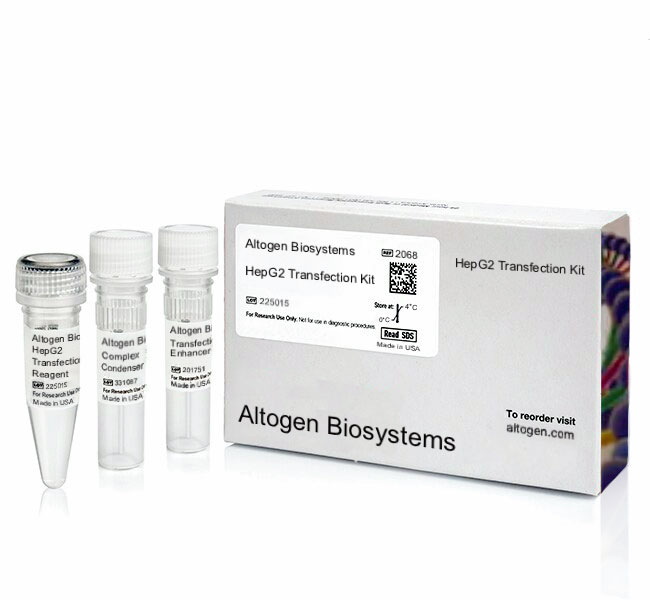
Volume Options:
- 0.5 ml (Catalog #2067)
- 1.5 ml (Catalog #2068)
- 1.5 ml CRISPR (Catalog #2154)
- 8.0 ml (Catalog #2069)
Purchase Orders: Click “Add to Cart” button to order, then email PO to orders@altogen.com.
Product Availability: In Stock.