




Description
Purchase Orders: Click “Add to Cart” button to order, then email PO to orders@altogen.com.
Product Availability: In Stock.
Transfection Reagent for HT-29 Cells (Colorectal Adenocarcinoma Cells)
- A nanoparticle-based liposome formulation
-
Transfection protocols provided for transfection of proteins, DNA, mRNA, siRNA, shRNA and microRNA
- Produce higher level of recombinant protein expression with minimal disruption of normal cell function
-
Generate physiologically relevant data you can trust
-
Effective for plasmid DNA/siRNA co-transfection
-
Easy-to-use transfection protocol with reproducible results
-
Low cytotoxicity
-
Download in vitro HT29 transfection protocol: [PDF]
- Download HT29 CRISPR/Cas9 transfection protocol: [PDF]
-
Download PowerPoint presentation for HT-29 cells transfection kit: [PPT]
- UPC/GTIN/EAN: 860002089775
-
Brand: ALTOGEN®, developed and manufactured by Altogen Biosystems
Transfection Efficiency:
Reagent exhibits at least 70% transfection efficiency of siRNA delivery. Transfection efficiency was determined by qRT-PCR.
Product Description:
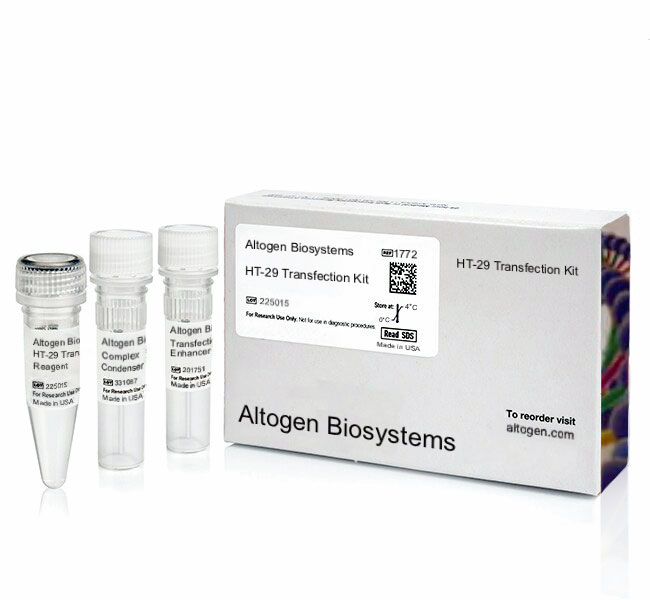
High efficiency transfection kit for HT-29 cells. Transfection kit includes transfection reagent, complex condenser and transfection enhancer.
Transfection Protocol and SDS:
Download Altogen Biosystems Transfection Protocol: [PDF]
Download SDS: [PDF]
HT-29 Cell Line:
HT29 is a human colon cancer cell line that was originally derived from a primary tumor in a patient with colorectal adenocarcinoma. HT-29 cells are notable for their ability to form differentiated epithelial-like structures in vitro, which makes them a valuable tool for studying colon cancer differentiation and development. Researchers also use HT29 cells to investigate the molecular mechanisms underlying cancer development and progression, and to identify potential therapeutic targets and biomarkers of the disease. According to the Colon Cancer Alliance (CCA), the incidence rates for colon cancer are on the rise in patients younger than age 50, and new treatment regimens are desperately needed. The tumorigenic HT-29 colon cancer cell line is an important tool for the synthesis and investigation of novel cancer drugs. HT-29 was derived in 1964 from the tumor of a 44-year-old woman with colon adenocarcinoma. HT29 cells are human intestinal epithelial cells, which produce the secretory component of Immunoglobulin A (IgA) and carcinoembryonic antigen (CEA). The HT-29 line is designated heterotransplantable, forming well-differentiated grade I tumors. The structure of HT-29 cells include microvilli, microfilaments, mitochondria, smooth and rough endoplasmic reticulum with free ribosomes, lipid droplets, limited primary lysosomes and many secondary lysosomes. The cells express urokinase receptors but do not have detectable plasminogen activator activity. HT-29 cells have been shown to be negative for CD4, but there is expression of galactose ceramide. HT-29 cells are commonly employed for tumorigenicity studies. Also, the HT-29 cell line is extensively used as model system to study epithelial differentiation in vitro. The HT-29 cell line a suitable host for gastric cancer research as well as for studying human infections related to the stomach. Altogen Biosystems offers nanoparticle-based transfection reagent kits that have shown low cytotoxicity for the HT-29 cell line.
Mutations:
| BRAF | 673 | 37 | 7 | 140453136 | 140453136 | Missense_Mutation | SNP | A | T |
| TP53 | 7157 | 37 | 17 | 7577120 | 7577120 | Missense_Mutation | SNP | C | T |
| LRRC7 | 57554 | 37 | 1 | 70486792 | 70486792 | Missense_Mutation | SNP | G | A |
| VCAN | 1462 | 37 | 5 | 82875982 | 82875982 | Splice_Site | SNP | G | A |
| VSTM1 | 284415 | 37 | 19 | 54567035 | 54567035 | De_novo_Start_OutOfFrame | SNP | G | A |
| HDAC4 | 9759 | 37 | 2 | 240056275 | 240056275 | Missense_Mutation | SNP | G | A |
| DSP | 1832 | 37 | 6 | 7583974 | 7583974 | Missense_Mutation | SNP | G | A |
| MUC17 | 140453 | 37 | 7 | 100695124 | 100695124 | Silent | SNP | C | T |
| E2F1 | 1869 | 37 | 20 | 32267636 | 32267636 | Missense_Mutation | SNP | C | T |
| PZP | 5858 | 37 | 12 | 9310407 | 9310407 | Missense_Mutation | SNP | C | T |
Data:
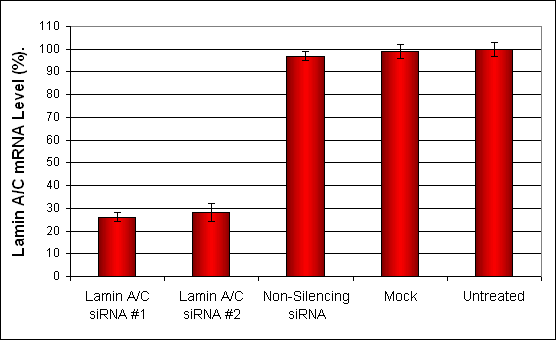
Figure 1. siRNAs targeting Lamin A/C mRNA or non-silencing control siRNA were transfected into HT-29 cells following the recommended protocol. At 48 hours post-transfection the cells were analyzed by qRT-PCR for Lamin A/C gene expression levels. 18S rRNA levels were used to normalize the Lamin A/C data. Values are normalized to untreated sample. Data are means ± SD (n=4).
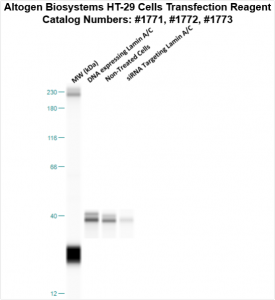
Figure 2. Protein expression of Lamin A/C in HT-29 cells. DNA plasmid expressing Lamin A/C or siRNA targeting Lamin A/C were transfected into HT-29 cells following Altogen Biosystems transfection protocol. At 72 hours post-transfection the cells were analyzed by Western Blot for protein expression levels (normalized by total protein, 10 µg of total protein loaded per each well). Untreated cells used as a negative control.
Selected HT-29 transfection reagent citation references:
- Clin Cancer Res. 2010 16(16). Inhibition of Hypoxia Inducible Factor-1α by Dihydroxyphenylethanol … Terzuoli et al [PDF]
- Oncogene. 2012 (31). EGFR signaling upregulates expression of microsomal prostaglandin E … Donnini et al [PDF]
- Clinical Cancer Research 2010 Aug 15;16(16):4207-16. Inhibition of hypoxia inducible factor-1alpha by dihydroxyphenylethanol, a product from olive oil, blocks microsomal prostaglandin-E synthase-1/vascular endothelial growth factor expression and reduces tumor angiogenesis. Terzuoli et al [PDF]
Altogen Biosystems provides preoptimized transfection products for life science research applications. Transfection protocols are optimized for individual cancer cell lines. Altogen Biosystems developed two types of in vivo delivery kits for animal research: Tissue-targeted reagents (delivery to liver, pancreas, and kidney tissues), and broad range in vivo delivery reagents (PEG-Liposome, Nanoparticle-based, Lipid-based, and Polymer-based kits). Advanced formulation of reagents and optimized transfection protocols provide efficient intracellular delivery of proteins, DNA, RNA, and any other negatively charged molecules in vitro and in vivo. Read more about transfection technology at Altogen’s Transfection Resource. Altogen Labs provides GLP compliant contract research studies for preclinical research, IND applications, and drug development. Services include: Xenograft services, development of stable cell lines, ELISA assay development, cell-based and tissue targeted RNAi studies, safety pharmacology/toxicology assays, and more (visit AltogenLabs.com).
Volume Options:
- 0.5 ml (Catalog #1771)
- 1.5 ml (Catalog #1772)
- 1.5 ml CRISPR (Catalog #2157)
- 8.0 ml (Catalog #1773)
Purchase Orders: Click “Add to Cart” button to order, then email PO to orders@altogen.com.
Product Availability: In Stock.