




Description
Purchase Orders: Click “Add to Cart” button to order, then email PO to orders@altogen.com.
Product Availability: In Stock.
Transfection Reagent for PC-12 Cells (Rat Pheochromocytoma Cells, CRL-1721)
-
Two component formulation enhances lipid mediated transfection efficiency
-
Optimized easy-to-use transfection protocol provided for transfection of siRNA, DNA, mRNA, and microRNA
-
Kit includes Transfection Enhancer reagent and recommended transfection protocol
-
Expand your RNAi application with a reagent optimized for delivery of both siRNA and plasmid
-
Download in vitro PC-12 transfection protocol: [PDF]
- Download PC12 CRISPR/Cas9 transfection protocol: [PDF]
- Download PowerPoint presentation for PC-12 cells transfection kit: [PPT]
- UPC/GTIN/EAN: 860002089794
-
Brand: ALTOGEN®, developed and manufactured by Altogen Biosystems
Transfection Efficiency:
Reagent exhibits at least 80% transfection efficiency of siRNA delivery. Transfection efficiency was determined by RT-PCR.
Product Description:
Transfection reagent developed for PC-12 cell line and transfection protocols are optimized for maximum delivery efficiency.
Transfection Protocol and SDS:
Download Altogen Biosystems PC-12 Transfection Protocol: [PDF]
Download SDS: [PDF]
PC-12 Cell Line:
PC-12 cells are extensively used as a model for neuronal differentiation, investigating the effects of differentiation on exocytotic release, in particular. Not considered adult neurons, PC-12 cells can quickly differentiate into neuron-like cells due to their embryological nature with neuroblastic cells, exhibiting similar to neurons properties. PC-12 was originally derived in 1976 from a transplantable pheochromocytoma of the rat adrenal medulla. PC-12 are small and difficult to transfect cells with a limited amount of cytoplasm. They have an estimated population doubling time of more than two days. PC-12 cells stop dividing and terminally differentiate when treated with nerve growth factor, which makes them useful as a model system for neuronal differentiation. PC-12 treated with nerve growth factor stop proliferation, grow long neuritis, and exhibit cellular composition changes that are associated with neuronal differentiation. When PC-12 differentiate, they are even more difficult to transfect. Both nitric oxide and neuronal nitric oxide synthase are required for the differentiation of PC-12 cells. Research suggests PC-12 cells may represent a stage specific vulnerability to a known neurotoxic agent. The PC-12 cell line has a rounded morphology and tends to form clusters in culture. Also, PC-12 cells are hard to attach to non-coated plastic surfaces, which makes them difficult to culture.
PC12 cells are a type of rat adrenal gland cell line that is commonly used as a model system for studying neuronal differentiation and function. PC12 cells were first isolated in 1976 from a pheochromocytoma, which is a rare type of tumor that arises from the chromaffin cells of the adrenal gland. PC12 cells have several unique properties that make them useful for studying neuronal differentiation and function. When treated with nerve growth factor (NGF), PC12 cells undergo morphological and biochemical changes that mimic the process of neuronal differentiation, including the extension of neurites and the expression of neuronal markers. PC12 cells also respond to neurotransmitters and other stimuli in a manner similar to that of neuronal cells. The PC-12 cell line is an invaluable tool for studying adrenal glands as well as malignancies related to them. Also, the PC-12 cell line is a suitable model for studying brain diseases. PC-12 cells are pheochromocytoma cells that are not capable of synthesizing epinephrine. Though they have been known to produce norepinephrine, dopamine, and catecholamines. Cells from the PC-12 rat pheochromocytoma are a mixture of eosinophils and neuroblasts, whose differentiation can be modulated based on research needs. Altogen Biosystems developed lipid-based transfection reagent optimized for the PC-12 cell line.
Data:
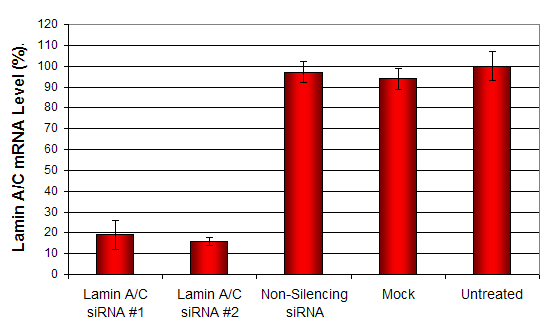
Figure 1. SiRNAs targeting Lamin A/C mRNA or non-silencing control siRNA were transfected into PC-12 cells following the recommended protocol. At 48 hours post-transfection the cells were analyzed by RT-PCR for gene expression levels. 18S rRNA levels were used to normalize the Lamin A/C data. Values are normalized to untreated sample. Data are means ± SD (n=3).
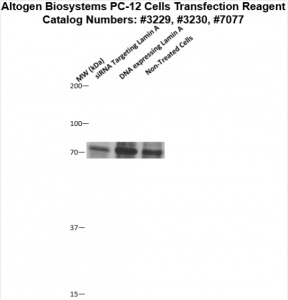
Figure 2. Protein expression of Lamin A in PC-12 cells. DNA plasmid expressing Lamin A or siRNA targeting Lamin A were transfected into PC-12 cells following Altogen Biosystems transfection protocol. At 72 hours post-transfection the cells were analyzed by Western Blot for protein expression levels (normalized by total protein, 10 µg of total protein loaded per each well). Untreated cells used as a negative control.
PC12 Transfection Reagent citations:
- J S Med. 2016 Dec;13(12):1834-1843. Off-Target Effect of Sildenafil on Postsurgical … Salmasi et al [PDF]
Altogen Biosystems is a life sciences company that offers cell type-specific and pre-optimized transfection products, elecroporation kits, and in vivo delivery reagents. Advanced formulation of reagents and optimized transfection protocols provide efficient intracellular delivery of protein, DNA, mRNA, shRNA and siRNA molecules. Read more about transfection technology at Altogen’s Transfection Resource. Altogen Labs provides safety and efficacy preclinical research services. GLP-compliant studies for IND applications, and drug development, including over 90 in-house validated xenograft models, safety toxicology, etc (visit AltogenLabs.com).
Volume Options:
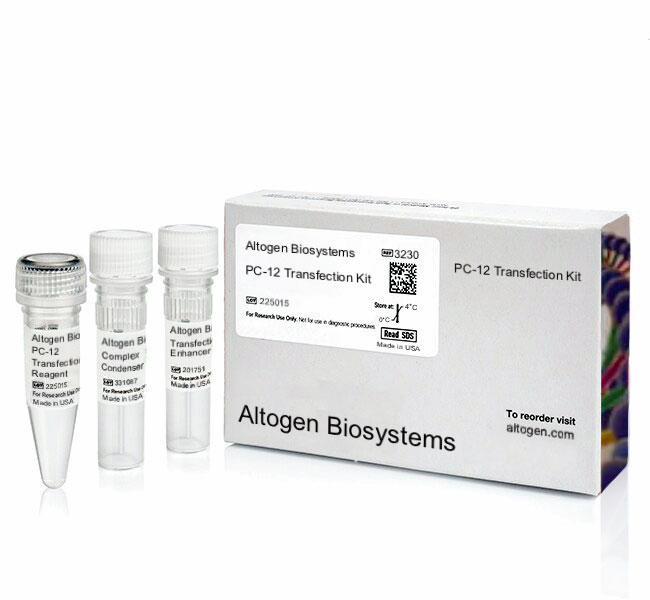
- 0.5 ml (Catalog #3229)
- 1.5 ml (Catalog #3230)
- 1.5 ml CRISPR (Catalog #2188)
- 8.0 ml (Catalog #7077)
Purchase Orders: Click “Add to Cart” button to order, then email PO to orders@altogen.com.
Product Availability: In Stock.