




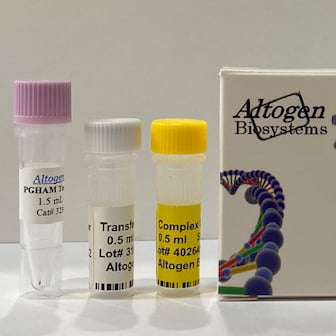
Description
Purchase Orders: Click “Add to Cart” button to order, then email PO to orders@altogen.com.
Product Availability: In Stock.
Transfection Reagent for PGHAM Cells (Hamster Pancreatic Carcinoma Cells)
-
Two component formulation enhances lipid mediated transfection efficiency
-
Optimized easy-to-use transfection protocol provided for transfection of siRNA, DNA, mRNA, and microRNA
-
Kit includes Transfection Enhancer and Complex Condenser reagents
-
Reproducible transfection results
-
Works well for standard reverse transfection and high-throughput applications
-
Download in vitro PGHAM transfection protocol: [PDF]
- Download PGHAM CRISPR/Cas9 transfection protocol: [PDF]
-
Download PowerPoint presentation for PGHAM cells transfection kit: [PPT]
-
Developed and manufactured by Altogen Biosystems
Transfection Efficiency:
Reagent exhibits at least 90% transfection efficiency of siRNA delivery. Transfection efficiency was determined by qRT-PCR.
Transfection Protocol and MSDS:
Download Altogen Biosystems PGHAM Transfection Protocol: [PDF]
Download MSDS: [PDF]
PGHAM Cell Line:
PGHAM1 is a human prostate cancer cell line that was established from a patient with prostate cancer. PGHAM1 cells are commonly used as a model system for studying prostate cancer and for evaluating potential therapies. Pancreatic cancer is a fatal disease with low survival and high mortality rate, which is considered a significant public health challenge. Due to the resistance of pancreatic cancer to radiotherapy and chemotherapy, new treatment approaches are urgently needed. Preclinical studies of the PGHAM-1 cell line can help to understand the etiology of the disease better and discover new therapies for patients with this life-threatening condition. PGHAM-1 cell line was derived from an N-nitrosobis(2-oxopropyl)amine (BOP)-induced pancreatic tumor of a Syrian hamster (Mesocricetus auratus). The tumors were minced and subcutaneously transplanted with a trocar into the interscapular area of untreated 5-week-old hamsters. The recipient hamsters were killed at 6–8 weeks after transplantation, and a portion of the tumor tissue was serially transplanted. After subcutaneous transplantation, the tumor was extracted under germ-free conditions. Cells that had been maintained in culture for 60 passages and had become established as a cell line were named PGHAM-1. The tumor showed a striking similarity to human pancreatic ductal adenocarcinoma and had a moderate to well-differentiated histology. PGHAM-1 contains a K-ras point mutation at codon 12, one of the most frequent types of K-ras mutation in human pancreatic cancers. Researchers have frequently used PGHAM-1 in experiments because of their cells’ rapid growth and a high rate of metastasis. PGHAM cells are beneficial in biomedical studies related to pancreatic cancer. The hamster pancreatic cancer cells of the PGHAM cell line greatly resemble human pancreatic cancer cells and are hence useful in cancer research. Altogen Biosystems provides high-efficiency transfection kits for the PGHAM cell line.
Data:
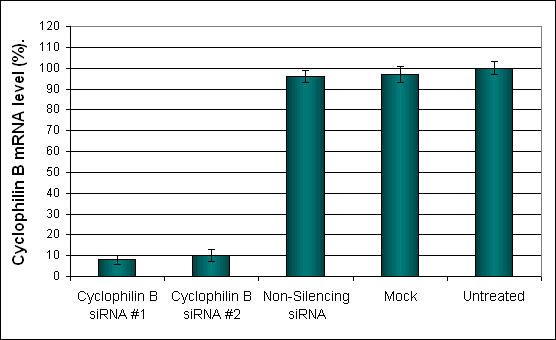
Figure 1. Cyclophilin B silencing efficiency was determined by qRT-PCR in the PGHAM cells transfected by Cyclophilin B siRNA or non-silencing siRNA control following the recommended transfection protocol. Cyclophilin mRNA expression levels were measured 48 hours post-transfection. 18S rRNA levels were used to normalize the Cyclophilin B data. Values are normalized to untreated sample. Data are presented as means ± SD (n=6).
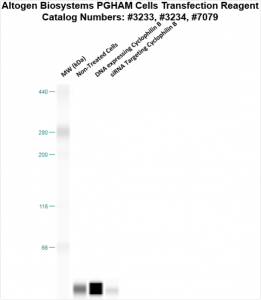
Figure 2. Protein expression of Cyclophilin B in PGHAM cells. DNA plasmid expressing Cyclophilin B or siRNA targeting Cyclophilin B were transfected into PGHAM cells following Altogen Biosystems transfection protocol. At 72 hours post-transfection the cells were analyzed by Western Blot for protein expression levels (normalized by total protein, 10 µg of total protein loaded per each well). Untreated cells used as a negative control.
Altogen Biosystems:
Altogen Biosystems manufacturers preoptimized transfection kits for cancer research. Reagents and transfection protocols are optimized for individual cancer cell lines. Altogen Biosystems developed two types of in vivo delivery kits for animal research: Tissue-targeted reagents (delivery into liver, pancreas, and kidney tissues), and in vivo biodistribution reagents (PEG-Liposome, Nanoparticle, Lipid, and Polymer-based kits). Optimized transfection protocols provide efficient cellular delivery of proteins, DNA, and RNA molecules. Read more about transfection technology at Altogen’s Transfection Resource.
Altogen Labs Contract Research Services:
Altogen Labs provides GLP-compliant contract research studies for preclinical research, IND applications, and drug development. Biology CRO services include: xenograft models (90+), development of stable cell lines, ELISA assay development, cell-based and tissue targeted RNAi studies, safety pharm/tox assays, and other studies (visit AltogenLabs.com).
Volume Options:
- 0.5 ml (Catalog #3233)
- 1.5 ml (Catalog #3234)
- 1.5 ml CRISPR (Catalog #2190)
- 8.0 ml (Catalog #7079)
Purchase Orders: Click “Add to Cart” button to order, then email PO to orders@altogen.com.
Product Availability: In Stock.